
Awning Windows: Ventilation, Style, and Everything Worth Knowing in 2026
Awning windows are hinged at the top and open outward from the bottom, creating a natural airflow channel that keeps fresh air moving through your home even during light rain. They are one of the most versatile window styles available for residential use, combining strong weather resistance with a clean, modern aesthetic.
Key Takeaways
- Awning windows are hinged at the top and crank open outward, which allows ventilation even in wet weather.
- Vinyl is the dominant material choice, holding 48.0% of the awning window market in 2026 (Future Market Insights, November 2025).
- Energy performance is a key advantage: fabric awnings alone can reduce heat gain by 55-65% on south-facing windows (ASHRAE).
- Awning windows typically cost more per unit than standard sliding windows, but the long-term energy savings can offset the difference.
- They pair well with casement windows and fixed picture windows as part of a layered ventilation strategy.
- Chattanooga Window Company can help you evaluate whether awning windows are the right fit for your home’s layout and climate needs.
Why the Hinge Position Changes Everything
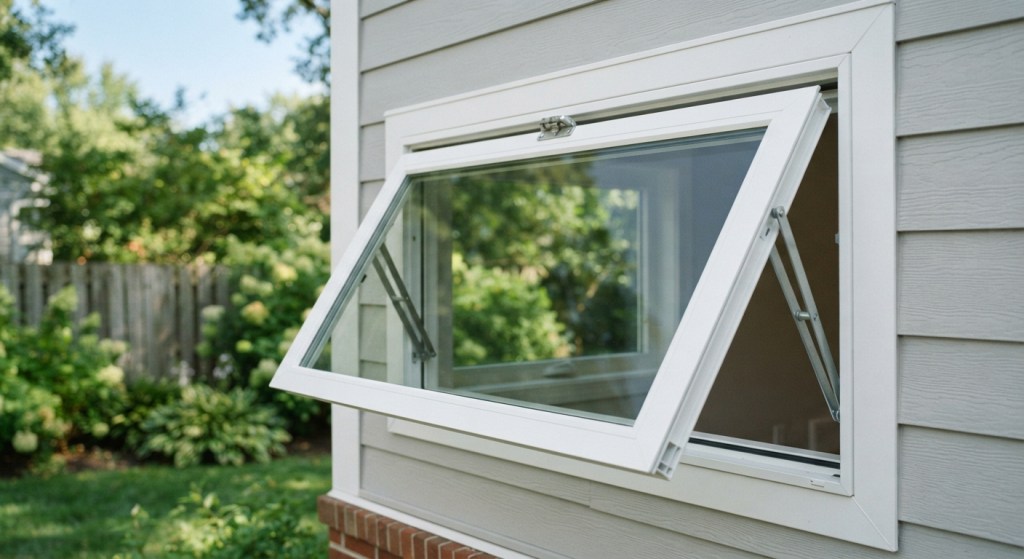
Most homeowners think about windows in terms of how they look from the street. What actually matters day-to-day is how air moves through them, and how protected they are from the elements. The top-hinged design of awning windows solves both problems at once.
When you crank the window open, the glass pane angles outward like a canopy. Rain hits the glass and rolls off to the sides rather than pouring in. This means you can leave the window open during a summer shower, something you simply cannot do with a double-hung or sliding window without soaking your interior sill. For homeowners in the American Southeast, where afternoon thunderstorms are a near-daily occurrence from May through September, this is a meaningful practical advantage.
The outward-opening angle also directs air upward into the room. Hot air naturally rises and escapes through the upper part of the opening, while cooler air enters from below. This creates a passive stack effect that can reduce your dependence on air conditioning during mild weather. According to the American Society of Heating, Refrigerating and Air-Conditioning Engineers (ASHRAE), fabric awnings reduce heat gain by 55-65% on south-facing windows and 72-77% on west-facing windows. While those figures apply specifically to fabric exterior awnings, the ventilation geometry of awning windows supports similar passive cooling principles in a hard-frame format.
The casement windows vs sliding windows comparison is worth reading if you are weighing your options across multiple window styles, since casement and awning windows share a similar crank mechanism but differ significantly in their opening axis.
Materials: What the Market Tells You About What Works

The material you choose for your awning windows affects durability, maintenance requirements, insulation performance, and long-term cost. The global awning window market sits at an estimated $852.3 million in 2026, projected to reach $1,225.7 million by 2035 at a compound annual growth rate of 3.7% (Future Market Insights, December 2025). That growth is being driven largely by residential renovation activity and tightening energy codes across the country.
Here is how the main material options break down:
| Material | Best For | Maintenance Level | Insulation Performance |
|---|---|---|---|
| Vinyl | Budget-conscious buyers, humid climates | Low | High |
| Wood | Historic homes, premium aesthetics | High | Very High |
| Aluminum | Commercial buildings, coastal areas | Low | Moderate |
| Fiberglass | Extreme climates, longevity | Very Low | Very High |
| Clad Wood | Premium residential, mixed climates | Low-Medium | High |
Vinyl dominates the category with a 48.0% market share in 2026 (Future Market Insights, November 2025). It does not rot, does not need painting, and holds up well in humid conditions like those common throughout Tennessee and the broader Southeast. Wood remains a premium choice for homeowners restoring period homes or seeking a warmer interior aesthetic. The wood awning window segment is projected to grow from $386.1 million in 2026 to $529.1 million by 2035 at a 3.2% CAGR (Future Market Insights, November 2025). Clad wood, which pairs a wood interior with an aluminum or vinyl exterior shell, was valued at $220.9 million in 2026 and is forecast to reach $305.7 million by 2035 (Furniture Market Insights, December 2025). It offers the visual warmth of wood without the exterior maintenance burden.
For energy performance specifically, the IMARC Group’s energy-efficient windows market analysis notes that awning windows currently hold the majority of total market share among energy-efficient window types, a reflection of how well the design supports thermal management when paired with modern glazing technology.
Where Awning Windows Fit Best in a Home
Not every window opening is a good candidate for this style. Awning windows tend to work best in specific placements:
- Above kitchen sinks or countertops: The low-profile crank mechanism means you do not need to reach far to operate them, and the outward angle keeps cooking steam and odors moving out.
- In bathrooms: Positioned high on the wall for privacy, they provide ventilation without sacrificing sightlines from outside.
- In combination with fixed picture windows: A large fixed pane flanked or topped by an awning unit gives you an expansive view with functional airflow.
- In basements or ground-level utility rooms: High placement allows ventilation while maintaining security, since the opening is too narrow and awkward to climb through.
They are less ideal for high-traffic exterior walls where an outward-swinging pane might obstruct a walkway, deck, or patio furniture arrangement. That is a real practical limitation worth planning around before you purchase.
Residential applications account for 62.0% of awning window demand in 2026 (Future Market Insights, November 2025), which aligns with how naturally the design fits single-family home renovation projects.
Cost Expectations for Awning Window Projects
What you pay depends on the size of the opening, the material you select, the glazing package (single, double, or triple pane), and your local labor costs. For a detailed breakdown of what to expect when replacing windows in 2026, the window installation cost 2026 guide covers both materials and installation labor across different window types.
Generally speaking, awning windows cost more per unit than basic sliding or double-hung windows. Their crank hardware, tighter tolerances, and weatherstripping requirements push the unit price up. On the other hand, the energy savings from superior air sealing and the ability to ventilate without running an HVAC system can reduce your utility bills over time. For a broader look at what replacement windows cost across all styles, the how much do new windows cost in 2026 resource from Chattanooga Window Company provides a realistic price range by material and installation complexity.
If you are replacing multiple windows as part of a home renovation, bundling awning units with other styles can bring the per-window cost down through volume pricing.
Energy Efficiency and Smart Integration Trends
Energy efficiency is no longer just about the glass. Approximately 72% of homeowners consider sun protection an important factor when upgrading outdoor spaces (Business Research Insights, 2026). That figure reflects a broader shift in how Americans are thinking about windows: not just as openings in a wall, but as part of an integrated thermal envelope.
Smart home integration is accelerating this trend. Motorized awnings with smart home integration now represent approximately 18% of newly installed residential awnings nationwide (Business Research Insights, 2026). While most of that figure applies to exterior fabric awning products, the technology is migrating into hard-frame window solutions. Motorized crank mechanisms for awning windows that respond to weather sensors, closing automatically when rain is detected, are becoming more widely available from major manufacturers. The US Windows Market overview from Custom Market Insights documents the growing influence of smart and energy-efficient products across all residential window categories.
For homeowners who want ENERGY STAR-certified options, pairing awning windows with low-E coatings and argon gas fill between panes is a straightforward path to qualifying for federal energy efficiency tax credits under current IRS guidelines. The IRS Energy Efficient Home Improvement Credit covers a portion of qualifying window replacement costs, so it is worth reviewing before you finalize your project budget.
How Awning Windows Compare to Other Common Styles
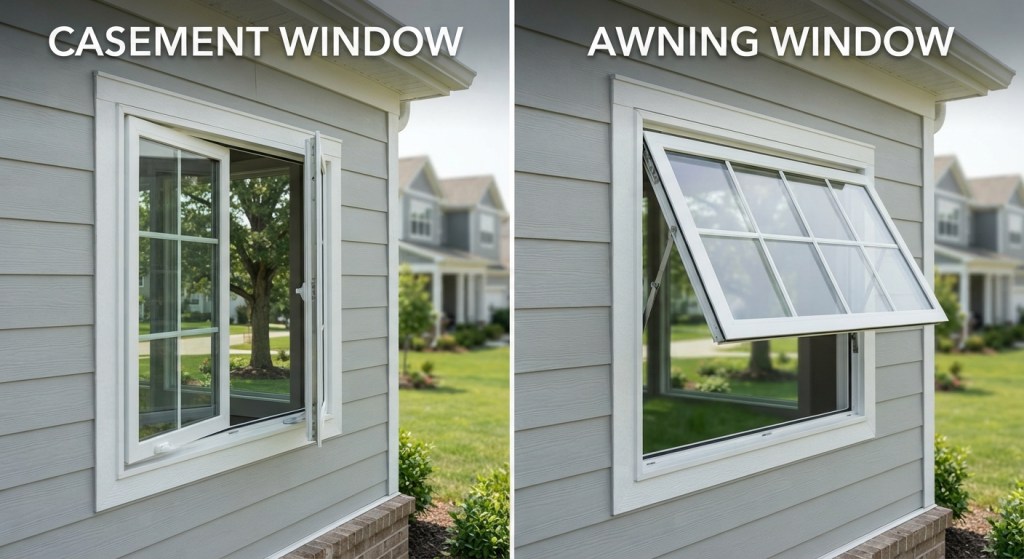
The most frequent comparison homeowners make is between awning windows and casement windows. Both use a crank mechanism and both seal tightly when closed. The key difference is the hinge axis: casement windows are hinged on the side and swing out like a door, while awning units are hinged at the top. Casements provide a larger opening and better for cross-ventilation in rooms where you want maximum airflow. Awning units are better when you need ventilation in rain-prone or high-humidity environments, or when the window is positioned high on the wall.
Sliding windows offer the simplest operation and the lowest unit cost, but they cannot match the air seal performance of a crank-operated window, and they are not functional during rain. Double-hung windows are the most common residential choice in the U.S. because they are familiar and affordable, but they sacrifice the weather-ventilation advantage that awning units provide.
The Windows Market Size and Outlook report from Market Research covers relative demand across all window types, including awning, sliding, casement, and fixed, which can help you understand where each style fits in the broader landscape.
Regional Demand and What It Means for U.S. Buyers
Demand for awning windows in the U.S. is being shaped by two converging pressures: stricter building energy codes and rising consumer awareness around thermal comfort. While global growth is partly driven by urbanization in Asia-Pacific markets (China leads at a 5.0% CAGR, according to Future Market Insights, December 2025), U.S. homeowners are responding to domestic incentives tied to energy performance and home resale value.
For buyers in the Southeast, including Tennessee, the combination of humid summers and unpredictable afternoon rain makes awning windows a particularly practical investment. Chattanooga Window Company works with homeowners across the region to match window styles to local climate conditions, installation constraints, and budget parameters. The goal is always a window that performs for your specific home, not just one that looks good on a spec sheet.
The Verified Market Research Awning Market Report provides additional context on demand drivers and product category growth through 2033, which may be useful if you are planning a multi-phase renovation and want to understand where the product category is heading.
The Bottom Line on Awning Windows
Awning windows are a strong choice for homeowners who want reliable ventilation, solid weather resistance, and a window style that holds up in humid, rain-prone climates without sacrificing energy efficiency. The design is not right for every application, particularly exterior walls with narrow clearance, but in the right placement, few window styles outperform them.
If you are weighing awning windows as part of a broader window replacement project, start by identifying which rooms and wall positions would benefit most from rain-tolerant ventilation. Then compare material options against your maintenance expectations and budget. Chattanooga Window Company can walk you through the right configuration for your home, including material selection, glazing options, and installation scheduling. Reach out to get a project estimate that reflects your specific needs and local conditions.
Frequently Asked Questions
Q: What is a window awning?
A window awning is a top-hinged window that cranks open outward from the bottom, creating a canopy-like angle that allows ventilation while blocking rain from entering.
The design is distinct from side-hinged casement windows and from sliding or double-hung units. When the window is closed, the sash presses firmly against the frame, creating a tight seal that performs well in both hot and cold climates. The term “awning” refers to the way the open pane resembles a fabric awning over a storefront, angled outward to shed water while still letting air through.
Q: What are the disadvantages of awning windows?
The main disadvantages of awning windows include limited opening size, potential clearance conflicts on exterior walls, and a higher per-unit cost compared to sliding or double-hung windows.
Because the pane swings outward, you need clear space on the exterior side of the window. This rules them out for walls that face directly onto walkways, patios with furniture, or tight side yards. The crank mechanism, while durable when well-maintained, adds a moving part that can wear out or become stiff over time, particularly in climates with extreme temperature swings. Additionally, the opening size is inherently smaller than what a full casement or double-hung window provides, which can limit airflow in rooms where maximum cross-ventilation is the priority.
Q: Which is better, casement or awning windows?
Neither style is universally better; casement windows provide a larger opening and stronger cross-ventilation, while awning windows offer superior performance in wet weather and work better in high-wall or bathroom placements.
Casement windows are hinged on the side and swing out like a door, which creates a wider opening and is more effective at catching prevailing breezes for cross-ventilation in living rooms and bedrooms. Awning windows hold the advantage when rain is a consistent concern, since the outward-angled pane acts as a shield. They also work better in spaces where privacy matters, such as bathrooms, because they can be positioned high on the wall without sacrificing operability. Your best choice depends on the specific room, wall position, and local climate conditions.
Q: What is the main purpose of an awning window?
The main purpose of an awning window is to provide consistent ventilation in wet or humid conditions without allowing rain to enter the home.
Standard window styles like double-hung or sliding windows must be closed when it rains, cutting off airflow exactly when outdoor temperatures might otherwise make mechanical cooling unnecessary. The top-hinged design solves this problem by angling the glass outward so that water rolls off the pane rather than dripping into the interior. Beyond weather resistance, the upward air direction created by the open pane supports passive cooling by allowing hot interior air to escape through the upper portion of the opening, which can reduce reliance on air conditioning during mild weather.
Q: Are awning windows more expensive?
Yes, awning windows are generally more expensive per unit than sliding or double-hung windows, largely because of the crank hardware, tighter frame tolerances, and more complex weatherstripping required.
The price gap varies by material and manufacturer, but you can typically expect to pay a premium over comparable-sized sliding windows. Wood and clad wood units sit at the higher end of the cost range, while vinyl awning windows offer the most accessible price point without sacrificing energy performance. Over time, the superior air sealing of a crank-operated window can translate into lower heating and cooling bills, which partially offsets the higher upfront cost. Bundling awning units with other window replacements in the same project is one of the most effective ways to reduce the per-window cost.
Making Your Final Decision on Awning Windows
Awning windows deliver a combination of weather resistance, passive ventilation, and clean aesthetics that few other window styles can match in the right setting. If your home sits in a climate with frequent rain, high humidity, or both, particularly in the American Southeast, the top-hinged design earns its higher price point through real, day-to-day functionality. The key is placing them in rooms and wall positions where their strengths are fully utilized: bathrooms, kitchens, high-wall placements, and combination installations with fixed picture windows.
Before you finalize your selection, take stock of your exterior clearances, your material preferences, and your overall project budget. Chattanooga Window Company works with homeowners throughout the Chattanooga area and the broader Southeast to identify the right window configuration for each specific home. Whether you are replacing a single problem window or planning a full-house renovation, the team can help you compare materials, glazing options, and installation logistics so your investment performs for years to come. Contact Chattanooga Window Company today to schedule a consultation and get a no-obligation estimate tailored to your home.